
Irremovable Footprints of Humans on the Earth
- Mar 16, 2016
- 3 min read
Earth, a unique place in our solar system which is place of abode to millions of organisms, including ourselves. No other planet we've yet discovered has the same delicate balance of conditions necessary to sustain life. Just one specie dominates it, us. Our cleverness, new initiatives and activities have affected almost every aspect of our planet. All natural cycles essential for a sustainable life, have been disturbed and the effect of this is globally visible as well as preserved in the rock records. The warmer and more stable climate heralded the inception of the Holocene (2 lac years ago- when first human appeared on earth). No longer constrained by the ice age, humans were free to finally make their mark and they did.
We moved from hunting and gathering to farming, we built major cities and civilisations. We came to rely more and more on technology. At some point, we graduated from adapting to our environment to making it adapt to us. The effects on the Earth were gradual at first and its biogeochemical and physical systems are extremely resilient as long as our numbers were few and ambitions modest, we had little impact on the planet as a whole.
But now (from recent 250 years) we regularly decelerate and accelerate natural processes, focus energy in extraordinary ways and alter, destroy or create diverse ecosystems. Stealthily at first, but then at a flabbergastingly rapid pace, we have left the Holocene behind and encompassed the Anthropocene {An epoch on the earth which totally dominated by the humans)
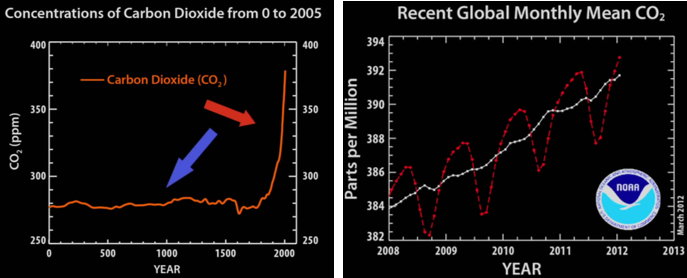
Anthropocene as a disaster
•Increased number of heavy rainfall events leading to more floods in some seasons or places and less overall rainfall leading to droughts in many others
•Decreased frequency of cold days and nights and frost.
•Increased frequency of hotter days and nights, and heat waves.
•Increased intensity of tropical cyclones and hurricanes (particularly in the North Atlantic). Intensity of droughts has increased with summer drying. In some regions, such as parts of Asia and Africa, the frequency and intensity of droughts have increased in recent decades.

Special report on emission scenarios
{IPCC (Intergovernmental Panel on Climate Change) Projections}
A1 storyline
It describes a future world of very rapid economic growth, global population that peaks in the 2050s and declines thereafter, and the rapid introduction of new and more efficient technologies.
A2 Storyline
It describes a very heterogeneous world. Economic development is primarily regionally oriented and per capita economic growth and technological change is more fragmented and slower than in other storylines.
B1 Storyline
It describes a convergent world with the same global population as of A1 but rapid change in economy with reduction in material intensity and use of green technologies.
B2 Storyline
It describes a world in which the emphasis is on local solutions to economic, social, and environmental sustainability. It is a world with continuously increasing global population at a rate lower than A2, intermediate levels of economic development, and less rapid and more diverse technological change than in the A1 and B1 storylines.
Projected Changes In Climate by 2100
• Temperature increases of 1.8 to 4.0oC, with warming expected to be greatest over land and northern latitudes, and least in the Southern Ocean and parts of the North Atlantic Ocean.
•Shrinking of sea ice in both the Arctic and Antarctic and likely disappearance of late-summer Arctic sea Ice.
•Increased ocean acidification added to increased ocean temperature.
•Increased severity and frequency of extreme events, such as tropical cyclones (hurricane and typhoons), heat waves, droughts and heavy precipitation events leading to floods.
What can be done?
Humans have ridden so far upon the back of technology that it would be very hard to recover now .But some efforts as follows may help to doctor up the impinging impacts so far-
LATEST LEGISLATIONS IN REGARDS TO CLIMATE CHANGE WITHIN NATIONAL AND INTERNATIONAL ARENA-
(Conference of parties 21 convention in Paris in November 2015)
The agreement was struck by the global leaders in order to contain the anthropogenic emissions to zero by second half of 21st century. All of the pursued endeavour must be directed to constrain the global rise in temperature to less than 2oC.
Adoption of stricter Vehicular norms within the country-
More hardy moves to curb the anthropogenic setbacks must be undertaken like the switching over to improved vehicle emission norms of Bharat Stage VI by 2019.
Judiciary within the country also ensures active participation in devising and implementing enactments for the control of anthropogenic outcomes.
For instance the decision of whipping up the diesel engines of 2000cc by an apex court is an appreciable effort.
Comments